We spend hundreds of dollars on serums promising to turn back the clock. We research ingredients until 2 a.m., and we religiously follow 10-step routines we saw on TikTok. We are trying so hard to keep our skin looking youthful and bouncy.
But what if the call is coming from inside the house?
It’s a terrifying thought, but some of the most common “healthy” skincare habits—the ones we think are doing us good—are actually accelerating the aging process. They are silently breaking down your collagen, weakening your skin barrier, and inviting fine lines to settle in years before they should.
I know this because I was doing three of them. When I finally visited a top-tier dermatologist, heartbroken over my sudden dullness and deepening forehead lines at 32, she didn’t recommend a stronger retinol. She told me to stop doing certain things.
The truth is, anti-aging isn’t just about what you put on your face; it’s about how you treat it when you think it can handle the pressure.
If you feel like you’re doing everything right but your skin is looking tired, saggy, or older than you feel, you need to read this list immediately.
You might want to sit down for number three—it changed everything for me.
1. The “Glass Skin” Obsession (Over-Exfoliation)
We live in the era of “glass skin.” We want that impossible, reflective sheen that looks like we just emerged from a glacial spring.
To get it, we have turned to acids. Glycolic, lactic, salicylic—we are slathering them on daily in toners, serums, and peel pads, chasing that instant glow of fresh skin cells.
It feels productive. It feels like it’s working because your skin feels baby-soft right after. But here is the part nobody talks about: that instant gratification is often long-term damage.
The “Squeaky Clean” Lie
When you over-exfoliate, you aren’t just removing dead skin cells; you are stripping away your moisture barrier. This barrier is the only thing keeping hydration in and irritants out.
Without a healthy barrier, your skin enters a state of chronic, low-grade inflammation. This inflammation is the archenemy of youth. It eats away at healthy collagen and elastin, leading to premature sagging and a crepey texture.
Dermatologist Weigh-In:
“I see women in their 20s with the skin barriers of someone much older because they are exfoliating twice a day,” says Dr. Elena Rostova, a cosmetic dermatologist based in New York. “If your skin feels tight, looks unusually shiny (plastic-like, not dewy), or stings when you apply moisturizer, you have gone too far. You are aging yourself in pursuit of a temporary glow.”
The Fix: Skin Cycling
Stop exfoliating every day. Embrace “skin cycling.” Use your exfoliating acids one night, a retinol the next, and then take two nights “off,” using only hydrating and barrier-repairing ingredients like ceramides and hyaluronic acid.
Internal link suggestion: how to repair a damaged skin barrier
2. The “Sunscreen Cheat” (Relying on Makeup SPF)
We all know we need sunscreen. If you are reading a beauty article in the U.S. today, you know that the sun is the number one cause of visible aging.
But so many of us are cheating, and we don’t even realize it.
We apply a foundation or a tinted moisturizer with “SPF 30” on the bottle and think we are protected for the day. We pat ourselves on the back for being responsible.
This is a massive mistake that is slowly letting UV damage accumulate on your face.
The Science of Coverage
To get the SPF protection listed on the bottle, you need to apply a specific amount of product—roughly a nickel-sized dollop, or two full fingers’ lengths, just for your face.
Nobody, and I mean nobody, applies that much full-coverage foundation. If you did, it would look like a mask.
When you apply a thin layer of SPF makeup, you aren’t getting SPF 30. You’re likely getting SPF 5 or 10. That means 90% of aging UV rays are still hitting your dermis, breaking down the support structures of your skin.
Dermatologist Weigh-In:
“Makeup with SPF is the icing on the cake, not the cake itself,” advises Dr. Rostova. “You must apply a dedicated, broad-spectrum sunscreen underneath your makeup every single morning. No exceptions. Relying on makeup is why I see sun spots on women who swear they never go outside.”
Internal link suggestion: best sunscreens that don’t pill under makeup
3. The “Tech Neck” Fold
This is the one that horrified me the most because I do it constantly.
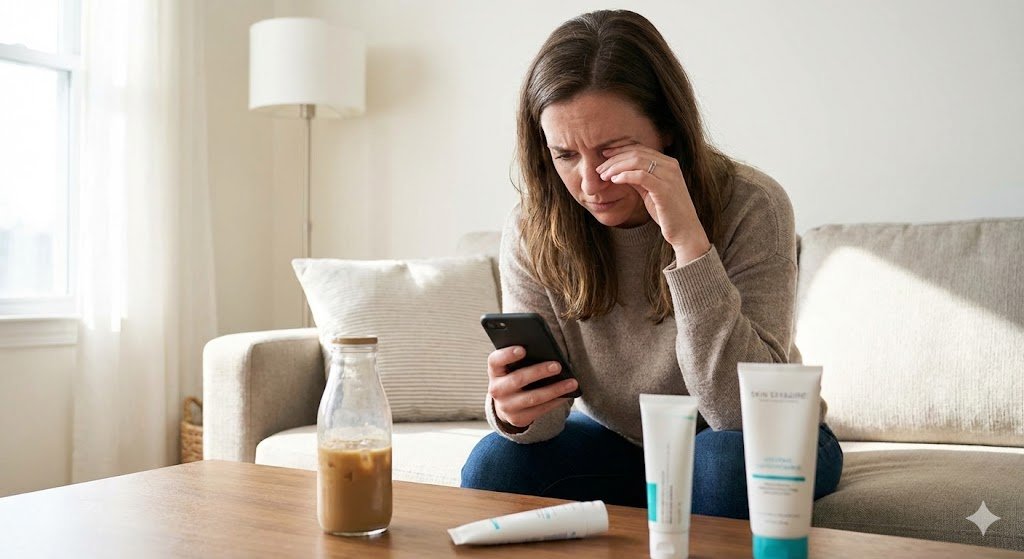
Think about your posture right now as you read this on your phone. Is your chin tilted down? Is your neck creased?
We spend hours every day looking down at screens. This repetitive folding of the neck skin, combined with the weight of gravity, is creating deep, horizontal wrinkles and sagging jowls in women as young as 25. It’s called “Tech Neck,” and it’s the fastest-growing aging concern in dermatology offices.
The Emotional Toll
I remember seeing a candid photo of myself at a brunch. I was looking down at a menu, and my jawline seemed to have vanished, replaced by a double chin and deep etchings across my throat. I looked ten years older than I felt. It wasn’t genetic; it was my iPhone habit.
What happened next surprised everyone I knew: I started holding my phone at eye level. It looks ridiculous in public, but my neck thanked me.
Furthermore, some research suggests the blue light (HEV light) emitted from our screens may contribute to oxidative stress in the skin, similar to UV rays, leading to hyperpigmentation and breakdown.
The Fix: Chin Up
Raise your screens. Hold your phone at eye level. Invest in a laptop stand. And do not neglect your neck in your skincare routine—bring your retinol and sunscreen all the way down to your chest.
Internal link suggestion: anti-aging neck creams that actually work
4. The “Sugar Sag” (Glycation)
You know sugar is bad for your waistline, but did you know it’s actively destroying the plumpness in your cheeks?
This is a biological process called Glycation, and it’s one of the sneakiest ways your lifestyle ages your face.
Simple Science Breakdown: Glycation
Imagine your collagen and elastin fibers are bouncy, flexible rubber bands that keep your face lifted.
When you eat excess sugar or highly refined carbohydrates (white bread, pasta), sugar molecules enter your bloodstream. These sugars attach themselves to fats and proteins—specifically, your collagen proteins.
This process forms harmful new molecules called Advanced Glycation End products (appropriately referred to as AGEs).
Think of AGEs like rust. They make your bouncy collagen rubber bands stiff, brittle, and discolored. Instead of snapping back, the skin sags. Instead of looking bright, it looks sallow and yellow.
If your diet is high in sugar, you are essentially caramelizing your collagen from the inside out. No amount of expensive cream can fix that.
Internal link suggestion: foods that boost collagen production naturally
5. The Physical Attack (Rubbing Your Eyes)
The skin around your eyes is the thinnest, most delicate skin on your entire body. It’s about the thickness of an eggshell membrane. It has almost no sebaceous glands to keep it moisturized, making it the first place to show fine lines.
Yet, we treat it aggressively.
We rub our eyes when we’re tired. We aggressively tug at the skin while trying to perfect our winged eyeliner. We use rough cotton pads to scrub away waterproof mascara at night.
The Mechanical Damage
Every time you tug, pull, or rub this delicate area, you are causing micro-tears in the underlying connective tissue. Over time, this constant mechanical stress breaks down elasticity.
The result? Chronic puffiness, dark circles caused by broken capillaries, and premature crow’s feet that have nothing to do with smiling.
The Fix: The Pat-Down
Treat your eye area like expensive silk. Never rub. Use an oil-based cleanser to dissolve mascara so it slides off without pulling. Apply eye cream using your ring finger (your weakest finger) with a gentle tapping motion.
What Women Are Saying
We asked our community which of these bad habits they were guilty of. The responses were eye-opening.
“I thought the tighter my skin felt after cleansing, the cleaner it was. I was practically scrubbing my face off with acids. Now that I’ve focused on hydration and barrier repair, my fine lines have actually softened. I was just chronically dehydrated.” – Sarah J., 34, Atlanta
“The Tech Neck thing is real. I noticed deep lines on my neck during Zoom calls last year. I bought a laptop stand and started putting my face cream on my neck, and it’s made a huge difference.” – Michelle K., 29, Chicago
“I was definitely guilty of the sunscreen cheat. I hated the feeling of sunscreen so I just used a tinted moisturizer with SPF 20. My dermatologist showed me the sun damage under a UV camera and I almost cried. Never skipping the real stuff again.” – Alisha R., 41, Los Angeles
The Science Explained (Recap)
Why do these habits actually age you? It comes down to three core pillars of skin health:
- The Barrier: Over-exfoliation destroys the protective shield, letting moisture out and aging irritants in.
- Structural Integrity: Sugar (glycation) and UV rays (lack of SPF) physically break down collagen and elastin, the scaffolding of your skin.
- Mechanical Stress: Constant looking down (Tech Neck) or rubbing eyes physically stretches and weakens the skin over time.
How to Do It the Right Way: The Anti-Aging Reset Routine
If you’ve been guilty of these habits, don’t panic. Your skin is resilient. Here is a simple, corrected routine to start repairing the damage.
Step 1: Gentle Cleanse Ditch harsh scrubs. Use a creamy or gel cleanser that doesn’t leave your skin feeling “squeaky” tight.
Step 2: Hydrate (Don’t Strip) Apply a hydrating serum with hyaluronic acid or glycerin to damp skin.
Step 3: Treat Wisely Use retinol at night, but start slow (2x a week). Save exfoliating acids for once a week, max, until your barrier is healed.
Step 4: Moisturize Daily Look for barrier-repairing ingredients like ceramides, fatty acids, and squalane.
Step 5: The Real Protect (Morning) Apply a dedicated SPF 30 or higher as your final skincare step, before makeup. ½ teaspoon for face and neck.
Common Mistakes to Avoid
- Using hot water to wash your face: It strips natural oils. Use lukewarm only.
- Sleeping on cotton pillowcases: The friction causes creases. Switch to silk or satin.
- Ignoring your hands: They age as fast as your neck. Put excess face products on the backs of your hands.
- Applying skincare aggressively: Always press and pat. Never drag downward.
Final Thoughts
It’s easy to get caught up in the hype of the newest “miracle” product, but the foundation of youthful skin rests on how you treat it every single day.
Aging is a natural privilege, but prematurely aging ourselves because of bad habits is unnecessary. By being gentler with your skin barrier, getting serious about SPF, and being mindful of your posture and diet, you can significantly slow down the clock.
Be kind to your skin. It’s the only outfit you wear every day of your life.
Read Next: The 7 Under-$20 Skincare Products That Dermatologists Actually Use
FAQ: Your Burning Questions Answered
1. How do I know if my moisture barrier is damaged from over-exfoliating? Signs of a damaged barrier include redness, increased sensitivity, burning or stinging when applying bland products (like moisturizer), unusual breakouts, and a tight, shiny appearance that feels dry underneath.
2. Is SPF 30 really enough, or do I need SPF 50+? For daily use, SPF 30 that is broad-spectrum (blocks UVA and UVB rays) is sufficient if you apply enough of it. SPF 50 offers marginally better protection, but the application amount matters more than the number on the bottle.
3. Can I reverse Tech Neck lines? Deeply etched lines are hard to fully erase with topicals alone, but you can significantly soften them. Using retinol on the neck, constant moisturization, and SPF will help. For deeper lines, in-office treatments like microneedling or lasers may be necessary. Prevention by changing posture is key.
4. Are natural sugars in fruit as bad for collagen as refined sugar? Generally, no. While fruit contains fructose, it is packaged with fiber, vitamins, and antioxidants that slow down absorption and fight oxidative stress. The biggest culprits for glycation are refined sugars, high-fructose corn syrup, and white flour products.
5. What is the best way to remove eye makeup without rubbing? Use a cleansing balm or oil. Massage it gently over closed eyes and let it sit for 15-30 seconds to dissolve the makeup. Then, add water to emulsify it and rinse away. If using a micellar water pad, press and hold it on the eye for 20 seconds before gently wiping outward once.