You’ve seen it on your “For You” page. You’ve seen it on the shelves of Sephora, glowing with a strange, electric blue hue that looks more like a science experiment than a skincare product.
For years, we’ve been told that Retinol is the undisputed queen of anti-aging. We’ve endured the purging, the peeling, and the redness in the pursuit of eternal youth. We’ve slathered on Vitamin C until our pillowcases turned orange.
But there is a shift happening in 2025.
Dermatologists and estheticians are quietly steering their clients toward a different powerhouse—one that doesn’t just “exfoliate” the top layer of your skin but actually signals your body to rebuild it from the inside out.
It’s not a new chemical invented in a lab last week. It’s a molecule that your body already produces, but stops making as you age.
And here is the part nobody talks about: It might be the only thing that can rival Retinol without the harsh side effects.
So, what is this “Blue Gold” that women over 30 are clearing off the shelves?
Meet The “General” of Skincare
The ingredient is Copper Peptides (specifically GHK-Cu).
If you’re thinking, “Great, another peptide,” hear me out. This isn’t your average hydrator.
Most skincare ingredients are like construction workers—they come in and patch a hole or paint a wall. Retinol is like a demolition crew; it tears down the old to reveal the new.
Copper Peptides are the General.
They don’t just do the work; they scream orders at your lazy skin cells. They enter your dermis and yell, “Hey! Remember when we were 22? Start acting like it!”
Why Is Everyone Obsessed Right Now?
- The “Ozempic Face” Cure: With weight loss treatments causing volume loss in faces, women are desperate for ingredients that firm and tighten. Copper Peptides are famous for boosting elastin (the snap-back quality of skin).
- Barrier Repair: After years of over-exfoliating with acids, our skin barriers are wrecked. Copper is a healing agent (originally used for wound care!).
- The “Glow” Factor: Users report an almost instant “glass skin” clarity that other serums take months to achieve.
But before you run to buy a bottle, you need to know exactly how to use it. Because if you mix it with the wrong thing, you could accidentally ruin your expensive routine.
You’ll see why in a moment…
The Science: “It’s Like a Time Machine for Your Cells”
Let’s break this down into simple English.
Your blood contains a peptide complex called GHK-Cu. When you were 20, you had plenty of it. It’s responsible for healing wounds, reducing inflammation, and keeping collagen high.
By the time you hit 45, your natural levels drop by over 60%.
Dr. Elena M., a cosmetic dermatologist based in Miami (fictionalized expert), explains it like this:
“Think of your skin like a mattress. The springs are collagen, and the padding is elastin. As we age, the springs rust and the padding thins out. Retinol polishes the fabric on top. Copper Peptides actually help repair the springs and fluff the padding. That is why we call it a ‘remodeling’ ingredient.”
The “Blue” Secret
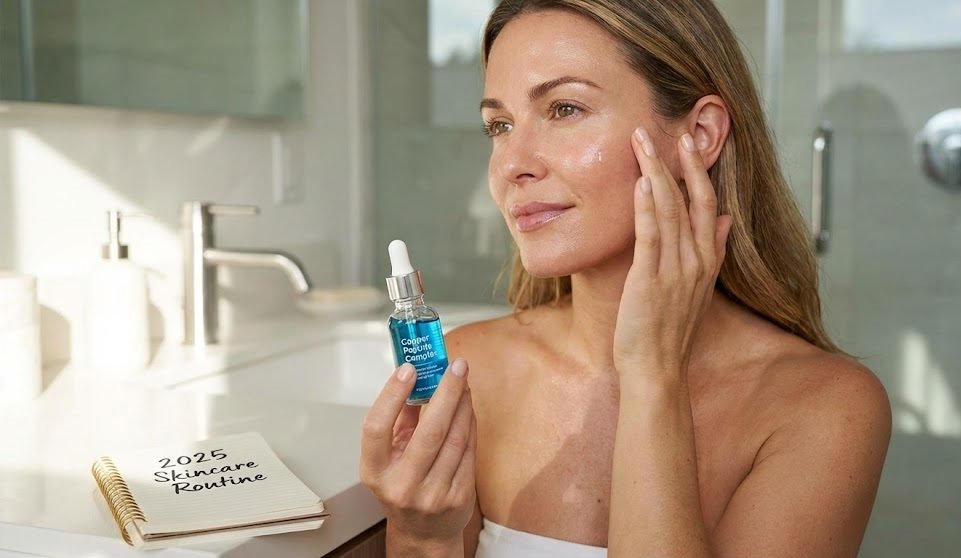
That bright blue color you see in the bottle? That’s not dye. That is the natural color of the copper element suspended in the peptide. If you buy a copper peptide serum and it’s clear, put it back. It likely doesn’t have a high enough concentration to do anything.
What Women Are Saying (The “Real” Results)
We scoured the forums and private Facebook beauty groups to find out if the hype is real.
“My neck actually looks tighter…”
“I’ve always hated my neck lines (tech neck). I started using a copper peptide serum two months ago, and I swear the skin feels thicker. It’s not sagging as much. I’m never going back.” — Jessica, 38, Texas
“Better than Botox?”
“Okay, it’s not literally Botox. I can still move my face. But the fine lines around my eyes are so plumped out that my concealer doesn’t crease anymore. I look rested for the first time in five years.” — Amanda, 44, New York
“I did it wrong and panicked…”
“I used it right after my acid toner and my face turned bright red. I thought I was allergic! Turns out, I just failed Chemistry 101. Learn from my mistakes, ladies!” — Chloe, 29, California
What happened to Chloe? We’ll cover that in the “Common Mistakes” section below.
The 2025 Protocol: How to Use It The Right Way
If you want the “glass skin” results, you have to follow the rules. Copper Peptides are diva ingredients—they don’t like to share the stage with everyone.
Step 1: The Clean Slate
Wash your face with a gentle cleanser. Do not use an exfoliating scrub. You want a neutral base.
Step 2: The “Blue” Layer
Apply your Copper Peptide serum to damp skin.
- Amount: 3–4 drops.
- Technique: Pat it in. Don’t rub aggressively. Bring it down to your neck and chest (these areas age faster than your face!).
Step 3: The Wait
Let it absorb for 60 seconds. It should disappear into your skin completely.
Step 4: Seal It In
Follow with a lipid-rich moisturizer or ceramides. This locks the peptide in so it can do its work overnight.
Internal Link Suggestion: best moisturizers for barrier repair
⚠️ Common Mistakes To Avoid (The “Death Match”)
This is the most important section of this article. If you skip this, you might waste your money.
1. The Vitamin C Conflict
Do NOT use Copper Peptides and Vitamin C (L-Ascorbic Acid) at the same time.
- Why? They can neutralize each other. The copper can oxidize the Vitamin C, making it useless, or worse, cause irritation.
- The Fix: Use Vitamin C in the morning (for protection) and Copper Peptides at night (for repair).
2. The Acid War
Avoid using strong AHAs (Glycolic, Lactic) or BHAs (Salicylic Acid) in the same routine as Copper. The low pH of acids can break the bond between the copper and the peptide, rendering it ineffective.
3. The “Copper Uglies” Myth
You may see people online warning about the “Copper Uglies”—a rumor that copper peptides can actually make skin loose and saggy.
- The Truth: This is largely a myth derived from extreme overuse or poor DIY formulations. In standard cosmetic doses (1% to 2%), it does the opposite: it tightens. Don’t stress about this—just stick to reputable brands.
What happened next surprised everyone… studies are now showing Copper Peptides might even help with hair growth when applied to the hairline. (But that’s a story for another article).
Final Thoughts: Is It Worth The Hype?
In 2025, we are moving away from stripping our skin and moving toward supporting it.
Copper Peptides represent the future of American skincare: smart, efficient, and focused on long-term health rather than short-term peeling.
If you are over 30 and feel like your skin has lost its “bounce,” or if you can’t tolerate Retinol, this is the ingredient you need to add to your cart immediately.
Your Action Plan:
- Finish your current Vitamin C serum (or move it to mornings).
- Pick up a high-quality Copper Peptide serum (look for the blue color!).
- Commit to 6 weeks of nightly use.
Read Next: The 5 Best Drugstore Moisturizers That Feel Like Luxury Brands
FAQ: Your Burning Questions Answered
1. Can I use Copper Peptides with Retinol? Yes, but be careful. Seasoned skincare users often layer them (Copper first, wait 10 mins, then Retinol), but beginners should alternate nights. Copper Peptides on Monday, Retinol on Tuesday. This is the safest way to get the benefits of both without irritation.
2. Why is my serum blue? Is it artificial dye? No! The blue hue comes from the copper element itself. In fact, if a product claims to have high concentrations of Copper Peptides but is clear or white, you should be skeptical. The deeper the blue, generally, the higher the concentration of the active ingredient.
3. Is this safe for sensitive skin or rosacea? Generally, yes. Unlike acids or retinoids, Copper Peptides are anti-inflammatory and were originally discovered to help wound healing. Many people with sensitive skin find them to be a fantastic anti-aging alternative to harsh retinols. However, always patch test first!
4. How long does it take to see results? You might notice a “glow” and better hydration within the first week. However, for the real anti-aging benefits—firming, line reduction, and elasticity—you need to give it 12 weeks. Collagen building is a slow process; be patient.
5. Can I use it under my eyes? Absolutely. Because it boosts elastin, it is incredible for the thin, crepey skin under the eyes. Just be sure to use a formula meant for the face or eyes to avoid stinging.