We’ve all been there. You’re standing in the fluorescent aisle of Sephora or scrolling through endless Instagram ads, wondering if that $85 “miracle cream” is actually going to erase the fine lines creeping around your eyes.
It’s exhausting, isn’t it? The beauty industry tells us we need a 12-step routine and a savings account dedicated solely to serums just to maintain a glow past our 30s.
But what if the secret to glass skin, plump cheeks, and erased wrinkles wasn’t in a gold-plated jar? What if it was sitting on the bottom shelf of your local drugstore, costing less than a latte and a bagel?
Here is the wildest part: It’s not a new chemical discovery. It’s not a rare orchid extract from the Amazon.
It is a humble, sticky, $10 tub that grandmothers have used for decades. And suddenly, women all over TikTok—specifically those over 35—are claiming it has taken ten years off their faces.
I was skeptical. Actually, I was terrified it would ruin my skin.
But then I saw the “before and after” photos. And you need to see what happened next.
The “Over-35” Skin Crisis
Let’s be real for a second. When you hit your mid-30s, your skin changes. It’s not just about wrinkles; it’s about texture and dullness.
You wake up looking tired even if you slept eight hours. Your makeup settles into lines you didn’t know you had. The “bounce” is gone.
Why? Because our natural oil production slows down. We lose moisture faster than we can replace it.
Enter the viral trend that is breaking the internet: “Slugging.”
Wait, What is Slugging?
Before you run away screaming at the name—stick with me.
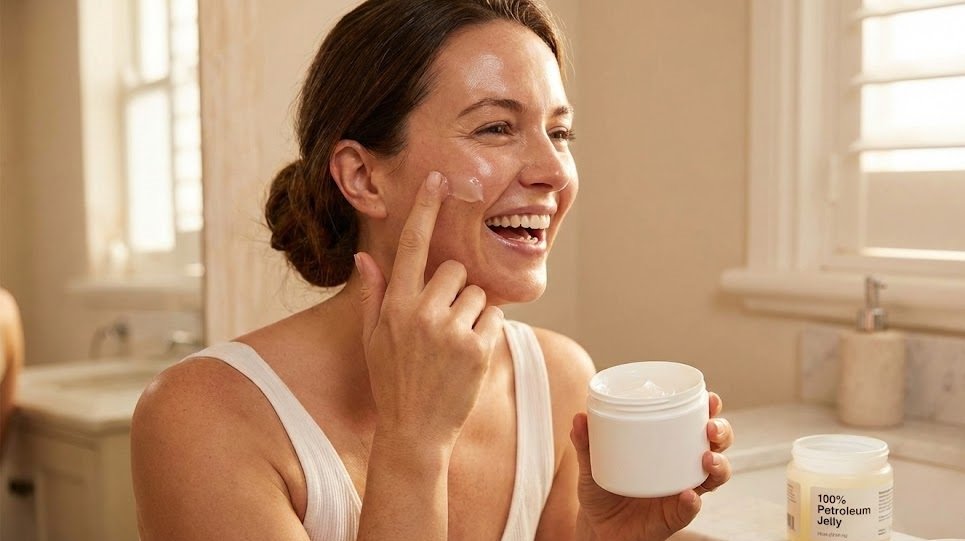
Slugging involves coating your face in a thin layer of an occlusive petrolatum-based ointment (think Vaseline, Aquaphor, or CeraVe Healing Ointment) as the very last step of your nighttime routine.
The goal? To turn your face into a literal greenhouse for moisture.
But does coating your face in “grease” actually work, or is this just another recipe for a massive breakout? The answer is more complicated—and fascinating—than you think.
The Emotional Truth: Why We Are Obsessed
I spoke to Sarah, a 39-year-old marketing manager from Ohio, who felt invisible.
“I felt like I looked ‘crispy,'” Sarah told me. “No matter how much water I drank or how expensive my moisturizer was, my skin looked parched. I looked exhausted. I tried this trick out of desperation because I was broke that month.”
Three days later?
“I woke up and touched my cheek, and it felt like a baby’s skin. My husband actually asked if I was wearing makeup. I wasn’t. I was just… glowing.”
Sarah isn’t alone. Thousands of women are ditching $300 La Mer creams for a $10 tub of Aquaphor.
But here is the part nobody talks about… you have to do it right, or you will regret it.
The Science: Why “The Greenhouse Effect” Works
Let’s get nerdy for a minute (but keep it simple).
Your skin has a barrier. Think of it like a brick wall. When that wall is damaged by age, retinol, or dry air, you experience something called Transepidermal Water Loss (TEWL).
Basically, the water inside your skin evaporates into the air while you sleep.
Here is what a dermatologist has to say:
“Think of your skin like a bucket with a slow leak,” says Dr. Emily Chen, a cosmetic dermatologist based in New York. “Most moisturizers add water to the bucket. But occlusives—like petrolatum—put a lid on the bucket. They physically prevent water from escaping. For women over 35, whose lipid barrier is naturally thinning, this ‘lid’ is the difference between waking up dry and waking up plump.”
The Science Breakdown:
- Molecule Size: Petrolatum molecules are too large to clog pores (for most people). They sit on top, not inside.
- Healing: It creates a moist environment that speeds up skin healing by 30%.
- Penetration: It forces the serums underneath to absorb deeper.
But wait… if it pushes ingredients deeper, that can be dangerous. (We’ll get to the “Retinol Burn” warning in a moment).
The Step-by-Step Guide: How to Do It The Right Way
You can’t just smear Vaseline on a dirty face and pray for a miracle. There is a specific “Sandwich Method” that insiders use to get that glass-skin look without the mess.
Step 1: The Cleanse
Wash your face thoroughly. You do not want to trap bacteria under the slugging layer. That is a one-way ticket to acne city.
Step 2: The Hydration (Crucial Step!)
Leave your skin damp. Apply a humectant serum (like Hyaluronic Acid or Glycerin). Internal Link Suggestion: best hydrating serums for dry skin
Step 3: The Moisturizer
Apply your regular daily moisturizer. Let it sink in for 60 seconds.
Step 4: The “Slug”
Take a pea-sized amount—yes, only a pea-sized amount—of your petrolatum product (Vaseline, Aquaphor, CeraVe).
Warm it between your fingertips until it melts.
Gently press (don’t rub) it over your face. You should look shiny, like a glazed donut.
Step 5: The Sleep
Go to bed. Yes, you might stick to your pillowcase. (Pro tip: Put a towel down).
The “Morning After” Reveal
When you wake up, you will look greasy. Don’t panic.
Use a gentle cleanser to wash off the layer. Underneath? That is where the magic happens.
- Plumpness: The lines around the eyes are softened because the skin is fully hydrated.
- Glow: The flakiness is gone.
- Smoothness: Makeup glides on like you’re using a primer.
But here is the catch that ruins it for 50% of people…
Common Mistakes That Will Ruin Your Face
This trick is powerful, but it’s not foolproof. If you skip this section, you might end up worse off than when you started.
1. The Retinol Trap Do NOT slug over strong actives like Retinol, Tretinoin, or Alpha Hydroxy Acids (AHAs) unless your skin is extremely tolerant. Why? The occlusive layer makes the retinol penetrate 10x deeper. This can cause chemical burns or massive irritation. Internal Link Suggestion: how to use retinol safely
2. The Acne Factor If you have oily or acne-prone skin, proceed with caution. While petrolatum is non-comedogenic (won’t clog pores), it traps everything. If you have oil or bacteria trapped underneath, you will break out. Internal Link Suggestion: skincare routine for oily acne prone skin
3. The Dirty Face Slugging locks things in. If you didn’t wash your sunscreen or makeup off properly, you are locking that dirt into your pores for 8 hours.
What Real Women Are Saying
We scoured the forums and comment sections to find the unfiltered truth.
The Good:
“I am 44. I have spent thousands on fillers and facials. Nothing gave me the glow that $5 Vaseline did. My husband thinks I’m crazy for going to bed looking like a rotisserie chicken, but he loves how I look in the morning!” — Jessica M.
The Bad:
“I tried this over my prescription acne cream. BAD IDEA. My face turned beet red and peeled for a week. Read the instructions, ladies!” — Morgan T.
The Ugly:
“RIP to my silk pillowcases. But honestly? Worth it.” — Sammy K.
The Verdict: Is It Worth The Hype?
If you are over 35 and your main concern is dryness, fine lines, and a lack of “bounce,” this $10 trick is arguably better than most $100 night creams.
It restores the skin barrier. It physically halts moisture loss. It gives you instant gratification the next morning.
However…
It is messy. It is unglamorous. And if you use active ingredients incorrectly, it can bite back.
But in an economy where a tiny jar of eye cream costs as much as a grocery run, finding a solution that actually works for the price of a sandwich feels like a victory.
Would you try it? Or is the “grease factor” too much for you?
FAQ: Your Burning Questions Answered
1. Will slugging cause acne? It depends. Petrolatum itself doesn’t clog pores, but it creates a seal. If you have active acne or trapped bacteria/oil, slugging can exacerbate it. It is best suited for dry, normal, or mature skin types.
2. How often should I do this? Start slow. Try it once a week. If your skin loves it, you can bump it up to 2–3 times a week, especially during the dry winter months.
3. Can I use baby oil or coconut oil instead? Generally, no. Oils are emollients, not true occlusives like petrolatum. Coconut oil is also highly comedogenic (pore-clogging) for many people. Stick to the basics: Vaseline, Aquaphor, or CeraVe Healing Ointment. Internal Link Suggestion: coconut oil vs vaseline for face
4. How do I save my pillowcases? This is the biggest downside! We recommend laying a clean, soft towel over your pillow, or doing your skincare routine 2 hours before bed so it has a chance to “set” slightly (though it won’t fully dry).
5. Is this safe for sensitive skin? Yes! In fact, pure petroleum jelly is often recommended by dermatologists for eczema and extremely sensitive skin because it contains no fragrances or preservatives. Just make sure you aren’t allergic to lanolin if you choose Aquaphor (which contains lanolin alcohol).
Final Thoughts
Beauty doesn’t have to be expensive to be effective. Sometimes, the best secrets are the ones our grandmothers knew all along.
If you’re ready to wake up with the plumpest skin of your life, grab that $10 tub and get ready to glow. Just remember: Pea size amount. Don’t rub. And protect your pillow.
Disclaimer: This article provides general information and does not constitute medical advice. Always patch test new products and consult a dermatologist for persistent skin issues.